ServicesCollision Repair
Collision Repair in Parlier
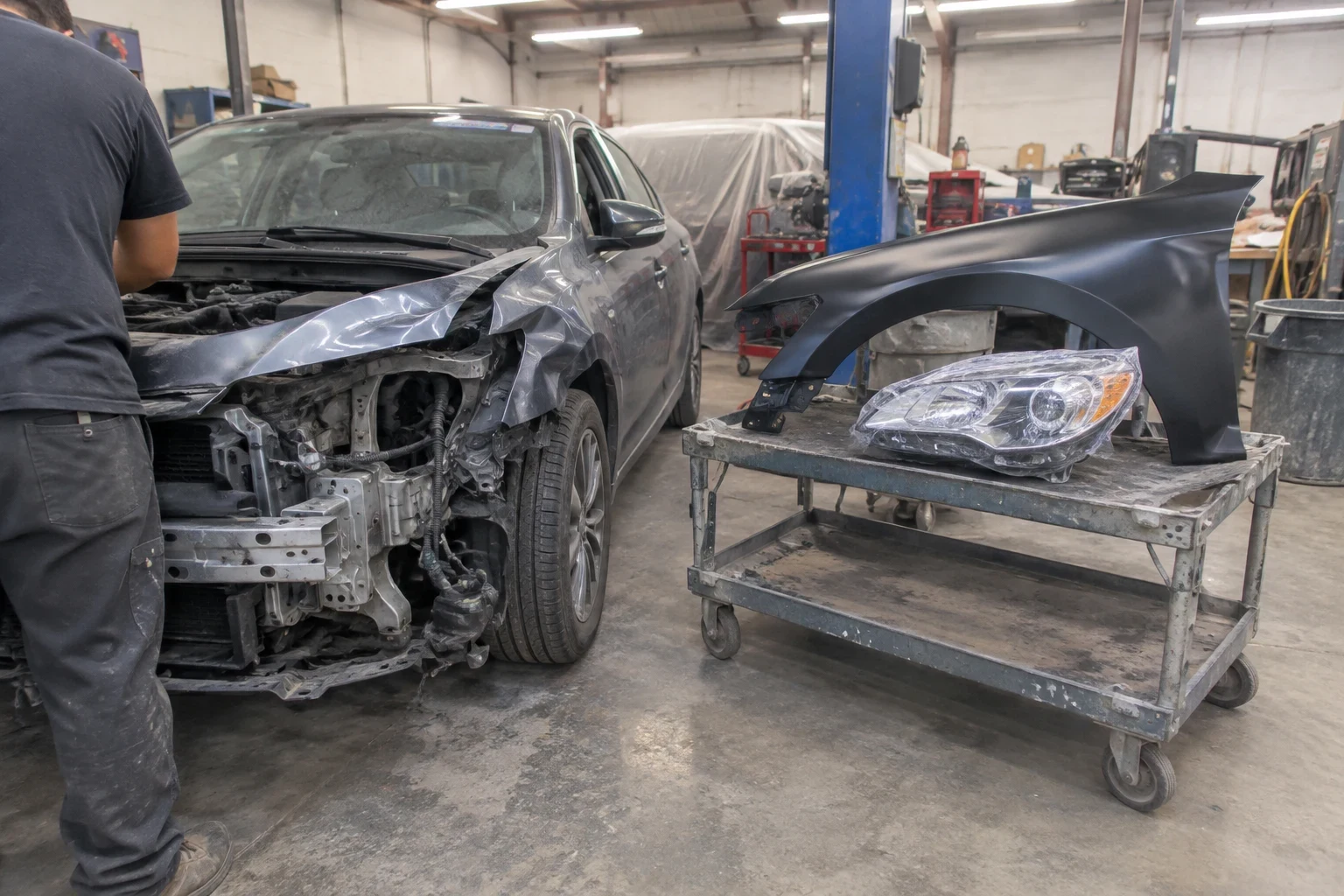
After a crash, the damage you see is rarely all of it. We remove the bumper cover and trim, measure the structure, and show you what the impact reached before we recommend a repair. You get a written estimate built from what we found, not a guess.
What collision repair covers
Collision repair is the work of putting a vehicle back to its pre-accident condition after an impact: structure, panels, mounts, paint and the electronics tied into them. It is the right call any time energy went into the body of your car, not just the surface. A dent in a door is a dent. A hit to a corner usually means a bumper reinforcement, a headlamp bracket and sometimes a radiator support moved too.
Modern unibody cars are designed to crumple in set zones so the cabin stays intact. That means a modest-looking hit can fold an inner rail or shift a mounting point by a few millimeters, enough to throw off panel gaps, wheel alignment or a radar sensor. We start by finding those changes, because a repair that skips them shows up later as a hood that won't line up or a warning light that won't clear.
What the repair includes
Teardown and damage mapping
The bumper cover, lamps and inner trim around the impact come off first, exposing the energy absorbers, brackets and reinforcement bars. Each damaged part is photographed and written onto the estimate.
Structural measuring
We compare the vehicle's measuring points to factory dimensions. When a point is out of spec, the car goes to our frame straightening work before any panel is hung.
Fix or replace, panel by panel
Steel that is dented but not stretched can usually be worked back to its original contour. Metal that has kinked or stretched loses the strength to hold a shape, and many high-strength steels shouldn't be heated at all, so those panels get replaced. We show you which call we made on each one and the reason for it.
Corrosion protection and sealing
Welding and straightening leave bare metal behind. We restore primer, seam sealer and cavity wax wherever the factory applied them, since an unsealed rail can rust from the inside where nobody sees it.
Refinish and blend
New and repaired panels are painted, then the color is blended into the panels next to them so it holds up in daylight and under shop lights. The paint and refinishing page covers that work in more depth.
Sensor checks and final fit
After reassembly we look at camera mounts, parking sensors and blind-spot radar, then check panel gaps, lamp aim and door closing before you get your vehicle back.
Signs your car needs more than a quick fix
Uneven panel gaps
A hood-to-fender gap that is wider on one side tells you something underneath shifted. Most often it is a moved mount or a bent apron.
Doors or trunk that stick
If a door suddenly needs a hard push, or the trunk lid won't latch on the first try, the opening itself may have changed shape in the impact.
Dash lights after the hit
A collision, lane-keeping or parking warning that shows up after an impact usually means a radar unit or camera is no longer aimed where the car expects it to be, often because its mount moved.
Drifting or uneven tire wear
A car that wanders after a curb strike or a corner impact may have a bent control arm, tie rod or subframe mount. An alignment alone won't correct a part that is physically bent.
Fluid under the front end
A puddle of coolant or washer fluid after a front hit usually points to the radiator, A/C condenser or a reservoir cracked behind the bumper cover.
How the job runs at our shop
- 1
Inspection and photos
You bring your car in and we look it over with you, then disassemble the damaged area. We photograph what we find, including hidden damage, so you can see it for yourself.
- 2
Written estimate
You get a line-item estimate listing parts, labor and refinish time. If more damage turns up once the repair is underway, we stop, document it and talk to you before going further.
- 3
Structure first, then panels
Any measuring or straightening comes first, because panels fitted to a crooked structure will never line up. Then panels are repaired or replaced, sealed and prepped.
- 4
Paint, reassembly and checks
Paint is applied and cured, parts go back on, and we check gaps, lights, sensors and road behavior. In the Central Valley's summer heat, cure time is controlled in the booth rather than rushed outdoors.
- 5
Walkthrough at pickup
We walk you around the vehicle, show what was replaced and answer questions before you drive away.
What moves the cost of collision repair
Collision repair prices vary widely because the cost tracks what happened behind the panels, not just the scuffs on top. A quick look in the parking lot can't see a bent absorber or a cracked bracket, so we build the estimate after taking the damaged area apart. Here is what changes the number the most.
- Damage to the structure
- A bent rail, apron or core support means measuring time, pulling on the frame machine and sometimes sectioning and welding. This is usually what separates a light estimate from a heavy one.
- Which parts go on
- Factory parts, aftermarket parts and recycled parts each carry a different price and a different fit. We go through the options part by part so the choice is yours.
- Color and refinish steps
- Tri-coat pearls and heavy metallics need extra coats and test panels to match. Blending color into the panels beside the repair also adds booth time.
- Driver-assist hardware near the hit
- Radar units, cameras and parking sensors live in bumpers, grilles and mirror housings. When the impact landed close to one, aiming or replacing it becomes part of the estimate.
Collision repair questions
Something not covered here? (559) 987-4445
Why can't you give me an exact price from photos?
Photos show the outer panel, and the outer panel is often the cheapest part of the repair. The absorbers, brackets and mounts behind it decide the real cost. We would rather inspect your car and give you a number we can stand behind than quote low and revise it later.
What if you find more damage after the repair starts?
It happens, especially after front-end hits. We stop, photograph the added damage and explain it to you before doing any extra work. If an insurance claim is involved, we send the documentation for a supplement.
Is my car safe to drive after a minor collision?
Often it is, but check for loose parts, fluid leaks, lights that don't work and warning lamps on the dash. If anything is hanging, leaking or pulling, it is better to have it towed than driven.
Do you work with my insurance company?
Yes. We can document the damage for your adjuster and handle supplements for hidden damage. Our insurance claims page explains how that works and what decisions stay with you.
Will my car look and drive the same afterward?
That is the goal of the repair: factory structural dimensions, even gaps, matched paint and working systems. We check each of those before pickup and walk you through what we did.
Get the full picture of the damage
Bring your vehicle to our shop in Parlier and we will show you what the impact reached and what it takes to fix it right. Drivers come in from Reedley, Selma and around the area.